The short version
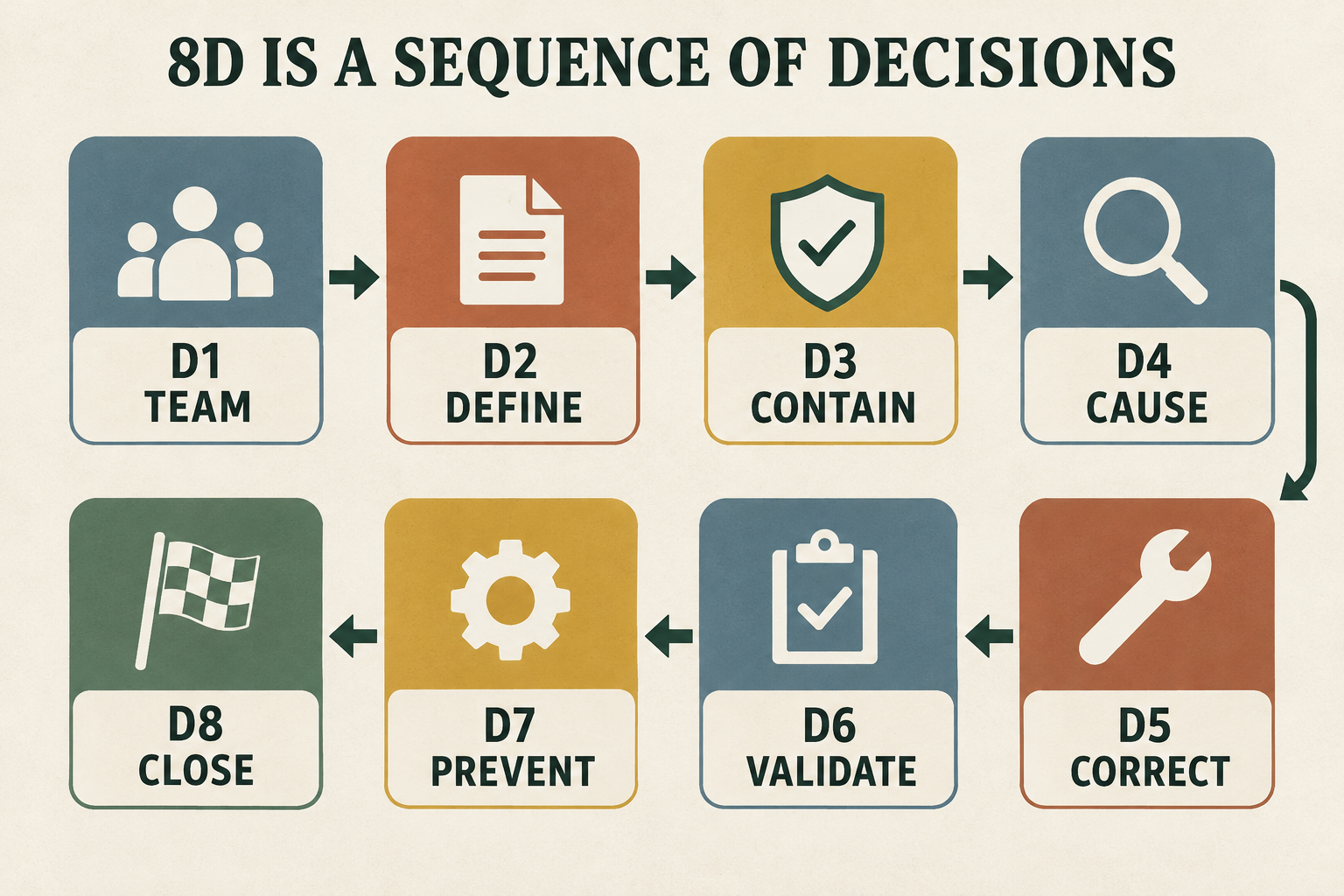
An 8D is not a form with eight empty sections. It is a sequence of decisions. Each discipline protects the next decision from being made with missing, weak, or premature evidence.
- D1 protects the team composition.
- D2 protects the problem definition.
- D3 protects the customer while the cause is still uncertain.
- D4 protects the investigation from plausible but unverified explanations.
- D5 and D6 protect action selection and validation.
- D7 protects the wider system from recurrence.
- D8 protects closure from becoming a signature without proof.
The report that looked complete
A customer reports an intermittent missing solder joint. The supplier sends back an 8D within a week. Every D-step contains text. D3 says operators were reminded to inspect the joint. D4 says the cause was human error. D5 adds a second inspection. D6 says the action was implemented. D7 says the work instruction was updated.
The report looks complete because the boxes are complete. But the team never established the exact affected population, never proved why the joint was missed, never showed that the inspection could detect the condition, and never defined what evidence would support closure.
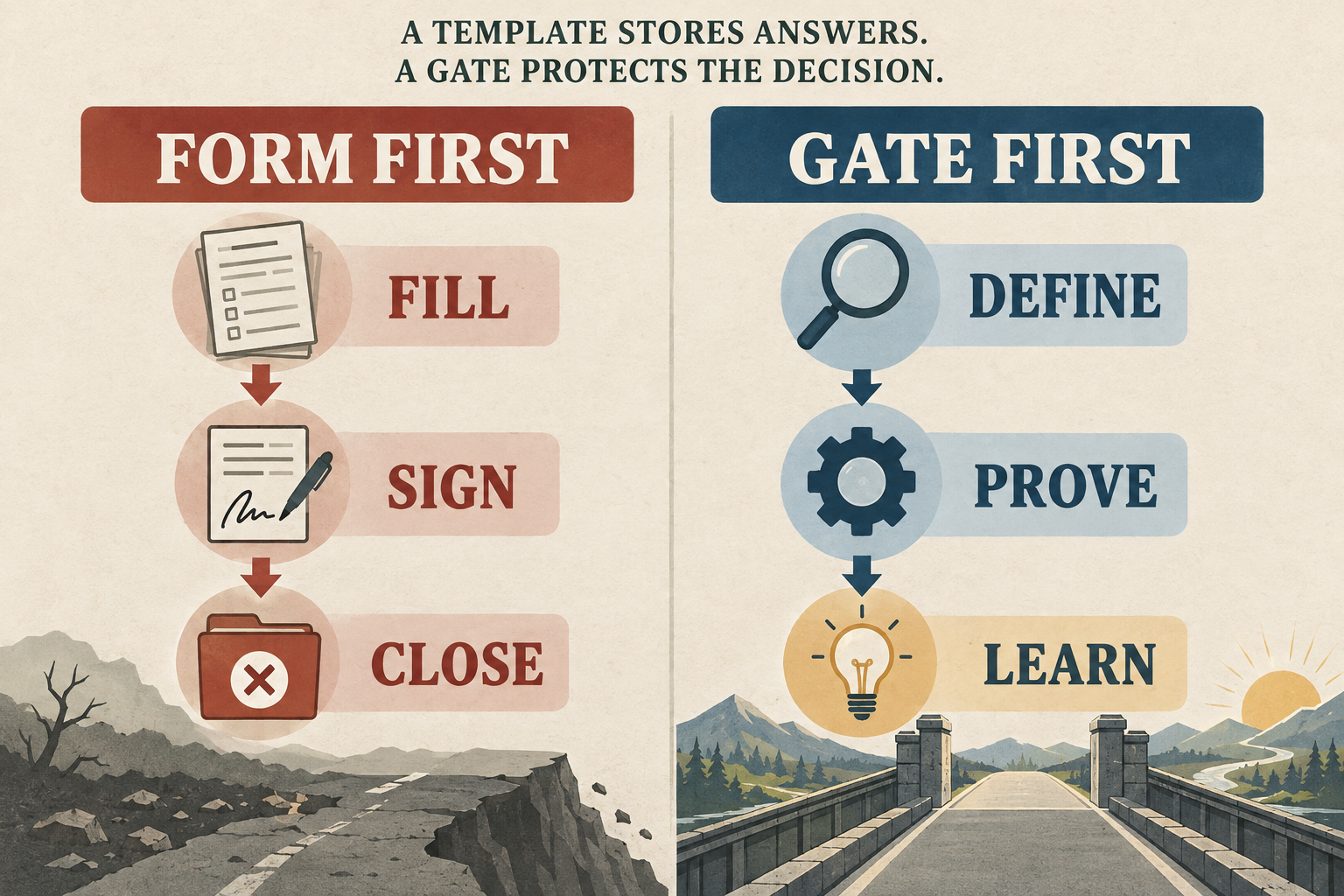
This is the difference between a report and a problem-solving system. The report records decisions. The gates protect them.
What a phase gate actually protects
ASQ describes 8D as a structured method that moves from team and problem definition through interim containment, root cause, corrective action, validation, prevention, and closure. The order matters because the later decision depends on the earlier one. A team cannot validate an action against an unbounded problem, and it cannot claim prevention when it has not shown what allowed the failure.
| Question | Symptom correction | Systemic corrective action |
|---|---|---|
| Sequence | Any section can be filled whenever information is available. | Later work waits until the earlier decision is sufficiently supported. |
| Evidence | A plausible explanation is written as though it were proven. | The cause, action, and result each have evidence appropriate to the decision. |
| Approval | A signature confirms that activity occurred. | Approval confirms that the gate condition and acceptance criteria were met. |
| Closure | The document is complete and the action is marked done. | Effectiveness evidence shows that the failure mechanism and escape risk changed. |
The eight decisions behind the eight disciplines
- 01
D1 — assemble the right team
Bring together the product, process, quality, and customer knowledge needed to make decisions. A team is not a list of names; it is the capability to test the problem from more than one angle.
- 02
D2 — make the effect measurable
Describe who, what, where, when, how many, and how the actual condition differs from the expected condition. Keep causes out of the problem statement.
- 03
D3 — protect while uncertain
Contain the suspect product, process, or customer exposure using an action with an owner, boundary, and verification. Containment buys time; it does not prove root cause.
- 04
D4 — prove the cause and escape
Explain why the problem occurred and why it was not detected or stopped. Verify the mechanism with records, observation, reproduction, tests, or comparison—not confidence in a familiar label.
- 05
D5 — choose a permanent correction
Select an action that addresses the verified cause and test whether it can solve the defined problem without creating a new risk.
- 06
D6 — implement and validate
Put the action into the real process and define evidence that the mechanism changed under realistic operating conditions.
- 07
D7 — prevent recurrence elsewhere
Review similar products, processes, documents, controls, suppliers, and risk analyses. Transfer the learning beyond the original case.
- 08
D8 — close with evidence
Record what was learned, what changed, what was verified, and who accepted the result. Closure is the conclusion of the learning loop.
D3 is not a smaller D4
Containment is often where the report first goes wrong. The team feels pressure to explain the issue immediately, so it describes a permanent correction as containment. That creates two problems: the customer may not be protected while the action is being designed, and the investigation becomes biased toward the first explanation written down.
Containment should answer: How will we prevent known or suspect exposure while we investigate? It may involve sorting, quarantine, temporary inspection, shipment controls, traceability checks, or a temporary process restriction. It needs a clear boundary and a way to verify that the protection is working.
It should not pretend to answer: Why did the failure happen? That is D4’s job.
D4 needs two causal paths
ASQ and other established 8D guidance distinguish the cause of occurrence from the cause of escape. The occurrence path asks why the defect or nonconformity was created. The escape path asks why the existing control did not detect it before the customer, next process, or decision point.
For the missing solder joint, “operator missed the inspection” is not enough. The team must ask what made the miss possible and what allowed the defective unit to escape:
- Was the joint visible from the inspection position?
- Was the inspection method capable of detecting the defect?
- Was the requirement clear at the point of work?
- Could the process continue when the inspection record was incomplete?
- Did the control plan describe the real failure mode and reaction?
If the two paths are collapsed into one “human error” answer, the action will likely be another reminder or training event. That may be useful, but it does not prove the mechanism changed.
Approval should mean “safe to decide”
A phase approval should be a short decision review, not a ceremony. The approver should be able to answer:
- Is the previous question bounded well enough?
- Is the evidence appropriate to the decision?
- Are the risks of moving forward understood?
- Is the next discipline now the right place to work?
A worked example: the missing solder joint
Effect: Four units from lot 24-A reached final inspection with an incomplete solder joint on the power connector. One unit reached the customer before the issue was detected.
The first gate is not “open the root-cause worksheet.” The team must define the affected lot, product variant, time window, station, operator context, and detection point. The containment decision then covers suspect stock, work in progress, shipments, and any related lots until the boundary is credible.
During D4, the team finds that the soldering fixture was changed during a product variant switch. The work instruction showed the standard fixture but did not identify the variant-specific setup check. The end-of-line visual inspection was performed from a position where the underside of the joint was partly hidden. The occurrence cause is a setup-control gap. The escape cause is a detection method that did not reliably expose the condition.
The permanent correction is therefore not just “train the operator.” It includes a variant-specific setup verification, a fixture identification control, and a detection method that makes the joint observable. D6 then defines a validation plan: reproduce the variant change, inspect the joint using the revised method, review the first defined production runs, and confirm that the old escape path is no longer available.
D7 asks where else the same setup and visibility assumptions exist. Only after that review can the team close with confidence.
The closure evidence should be designed early
FDA MDSAP QMS P0009 requires corrective-action planning to define roles, verification or validation protocols, acceptance criteria, timing, and the method used to determine effectiveness. It also states that effectiveness must be verified before the corrective action is successfully completed.
That means the D6 closure rule should not be invented on the final day. Decide early:
- what signal will reveal recurrence;
- which products, lots, shifts, or variants are inside the boundary;
- what operating exposure is enough to make the result credible;
- what result passes, fails, or triggers more work;
- who reviews the evidence and accepts the conclusion.
- Can the team describe the actual and expected conditions without hiding the cause inside the problem statement?
- Does containment protect the defined suspect scope while the cause is still uncertain?
- Are occurrence and escape causes investigated as separate questions where the control path requires it?
- Does every proposed cause have evidence showing how it could produce the observed effect?
- Does the permanent correction change the enabling condition instead of only reminding a person?
- Are validation and effectiveness criteria defined before the action is declared complete?
- Did D7 check similar products, processes, controls, documents, suppliers, and risk analyses?
- Does D8 record what changed and why the evidence is sufficient for closure?
Sources & further reading